Alkaline Protease for Silk Degumming and Sericin Removal
Bulk alkaline protease for silk mills, dye houses and textile-auxiliary suppliers who want softer silk and less chemical clean-up. Request a quote with your silk form, quantity and destination.
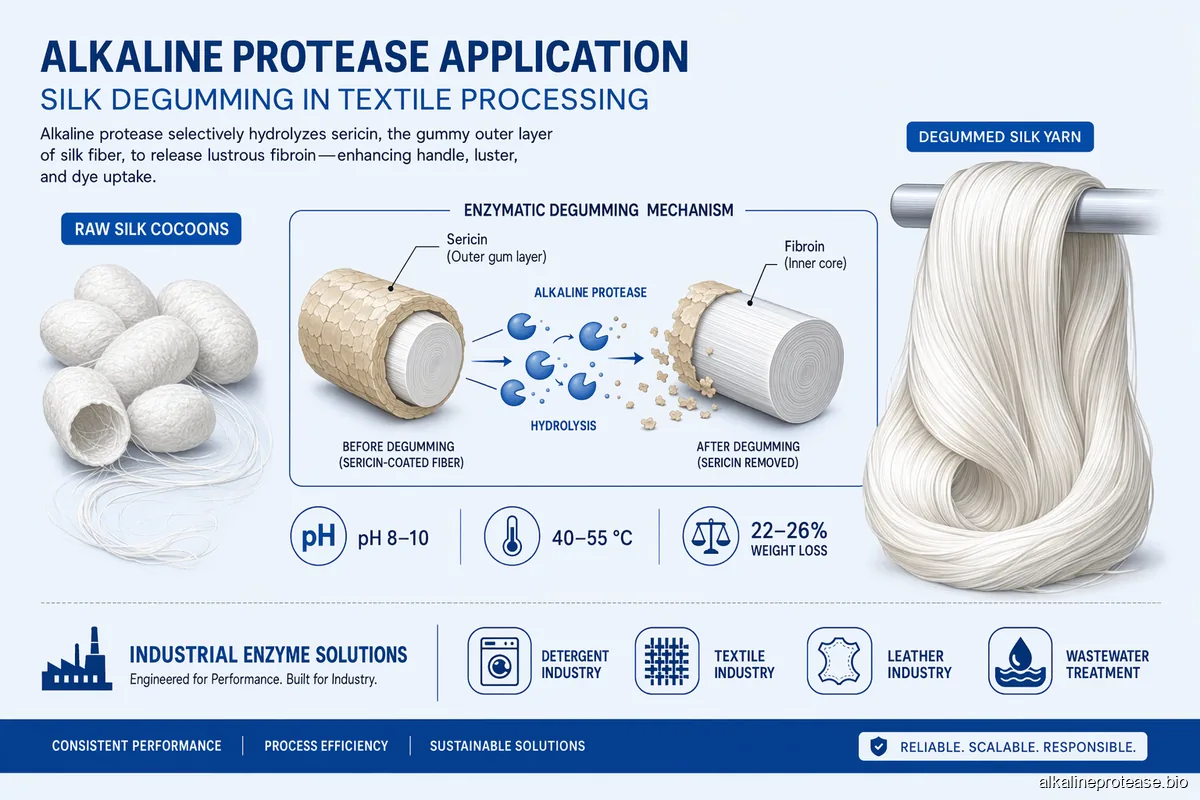
Mills that remove sericin and colour with chemical agents pay twice: the chemicals pollute, and the later clean-up adds cost. Silk treated with alkaline protease instead comes out fluffy, soft and comfortable, with less pollution and lower after-treatment cost. For a silk mill, that means fewer chemicals to buy and less to clean up afterwards. We supply alkaline protease in bulk to silk mills, dye houses and the textile-auxiliary companies that formulate degumming agents. To get a quote, email hello@mail.alkalineprotease.bio with your silk form, the quantity and the destination country.
How it works: Raw silk is held together by sericin, the gum protein around the fibroin core. Removing it gives silk its softness, lustre and even dyeing. Sericin is loose and water-accessible, while fibroin is tightly packed. Under mild conditions the protease removes sericin and leaves the fibroin core largely intact, so the fibre keeps more of its strength than after a hot, harsh chemical scour. Producers describe the enzyme's best working range as clearly alkaline and moderately warm, far below scouring temperatures; set your own bath conditions in a trial.
What decides the result is your silk form (filament yarn, woven fabric or spun silk and noil), its sericin load and your next step, usually dyeing or whitening. Measure weight loss and dye evenness in the trial, then scale.
Filament yarn degumming
Yarn on reels or bobbins is degummed in a protease bath at mild temperature instead of a long hot scour. Weight loss confirms that the sericin is off; compare yarn strength with your current process.
Woven silk fabric
Fabric exposes more surface, so it usually needs a shorter treatment. The aim is a soft hand and even dye uptake without surface damage from harsh chemicals.
Spun silk and noil
Short-fibre silk carries more and more variable sericin, so it typically needs a stronger enzyme step. A mild alkaline pre-wash can help the enzyme reach the gum.
Degumming then whitening
Run the protease step first, then adjust the bath for peroxide whitening. Keeping the steps apart protects the enzyme and still reaches the whiteness needed for top-grade piece-dyed silk.
Textile-auxiliary suppliers
Companies that sell degumming agents to silk mills buy protease in bulk for their own blends. We quote drum quantities per order with COA and TDS.
| Parameter | Value |
| Activity range | 100,000 – 200,000 U/g |
| Optimal pH | 8.0 – 10.0 |
| Optimal temperature | 40°C – 55°C |
| Form | White to light tan powder |
| Shelf life | 12 months (sealed, cool, dry place) |
| Packaging | 25 kg drums / custom packaging |
Frequently Asked Questions
Why use alkaline protease instead of chemical degumming?
Chemical agents remove sericin and colour, but they pollute and add after-treatment cost. Protease works under milder conditions and removes the sericin while leaving the fibroin largely intact, so silk comes out soft and fluffy with less clean-up.
How do you check that the sericin is fully removed?
Weight loss after degumming is the main check. Even dye uptake is a practical second check: poorly degummed silk dyes patchy. Use the same tests you use for your current process so you can compare directly.
What dose and conditions should we use?
It depends on silk form, sericin load and your equipment. Start in a mildly warm, alkaline bath, run a small trial at two or three doses, and pick the lowest dose that reaches your weight-loss and dyeing targets.
Is enzyme-degummed silk compatible with dyeing?
Yes. The protease step adds nothing that interferes with the dyes normally used on silk, and the enzyme is switched off by a hot rinse or by the change to the dye-bath pH. Silk with the sericin fully removed dyes more evenly.
Request a Bulk Quote for Silk Degumming Protease
Tell us your silk form (yarn, fabric or spun silk), the quantity and the destination country. We will recommend a grade, send a 100 g free sample with COA and TDS, and quote within 24 hours.
Request a Quote